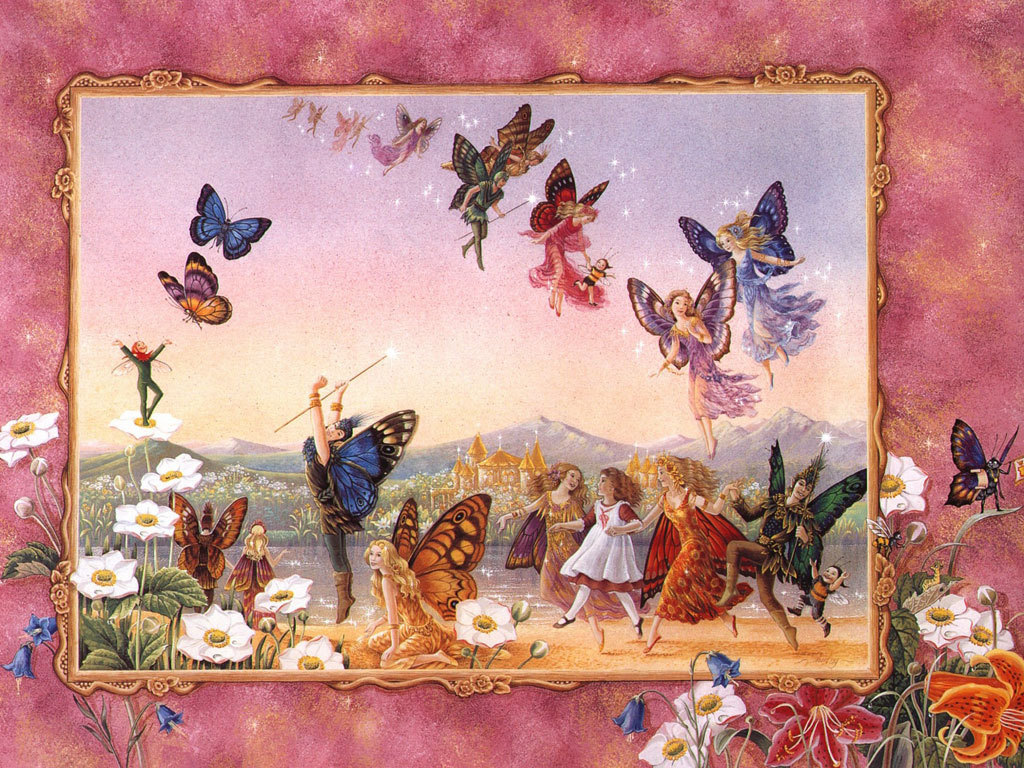
Fantasy Butterfly Wallpaper Biography
"IF I DIE THIS NIGHT, I WILL DIE A TOTALLY CONTENTED HUMAN BEING." I WHISPERED these words at the end of an unbelievable day in Lautenheim, a remote village in France where, for the first time, I had met my relatives in the old world.
Before I knew it, surrounded by loving relations who a moment before had been perfect strangers, I was entering the house that my great-great-grandfather had built. As my cousins proudly took me on a tour, I couldn't help but become a tangle of emotion and inspiration. When they opened the door to my great-great-grandfathers workshop, I felt close to him, just as I had felt when I spent hours in my grandfather's workshop, catching curled wood-shavings as they flowed from his plane.
It was a moment of contentment never to be forgotten, and in an attempt to capture it, I sketched the doorway that had welcomed me into the house. Looking back, I think this moment crystallizes my experience as an artist, combining my love of family and surroundings with my need to record them in my painting.
This need and desire to capture such moments has been part of me for as long as I can remember. So when people ask, "When did you become an artist?" I answer that I believe it isn't a case of becoming as much as it is a state of being.
While the simple desire to understand shape and colour is very natural to any child, it is the artist in you that never lets you outgrow that desire. In my case, the wonderful release of expression that art offers took many forms, but it always seemed to be influenced by my surroundings and the things that were important to me.
Ours was a simple, cozy home, yet rich in love and faith. We were always encouraged to do the best we could do, whatever that might be. As the second in a family of four daughters, in my early years I shared many moments that nurtured the feelings and values implicit in my work today. Those moments formed a cohesive memory, a bond that can never be broken, and for that reason understanding them is important in understanding my art.
I had a typical country childhood. Summer days were filled with catching butterflies and frogs, building forts in the woods, and fishing for sunfish in the creek. Winter was magical, with deep, billowing drifts of snow, thrilling toboggan runs, and a pond where we would skate by the light of the moon.
In our basement my mother set up an exciting, creative space. While the wood stove kept us warm, the work table and chalkboard kept my sisters and me busy for hours. We were allowed to paste anything we wanted on the wall with our homemade glue. True freedom of expression!
My early years were not, however, without pain. When I was four years old, I developed an ulcer on the cornea of my right eye, which eventually threatened my sight and had to be cauterized. My eyes were bandaged and I was put in isolation at the hospital. It was a traumatic experience, but I knew that I was not being abandoned; I had my favourite doll, and somehow I knew that God was always there.
I believe it was a miracle that saved my sight. When the bandages were removed for good, I felt an indescribable sense of light, freedom, and happiness. This experience was the beginning of my deep faith, which has remained firmly grounded ever since.
It was also another beginning, a new appreciation of sight. In my attempt to capture everything I saw, I began to draw. At first I drew what I knew well at the time - hospital rooms and nurses. When that subject had been exhausted I moved on to the things around me that I loved - horses and barns. And I have never stopped drawing what I see around me.
Every young artist needs reassurance, and when I was in the first grade it came to me in the form of a first prize in a small school art competition. However insignificant it may seem, this small taste of recognition was a great source of encouragement to me. In the years that followed, as County Fair time drew near, I would prepare pieces for entry in the various categories of art competition. This was never an easy thing to do because the perfectionist in me was never satisfied, so pieces never seemed finished. Needless to say, I was always amazed when I saw a first- or second-prize ribbon on my work.
When I entered junior high school, not only did I find diverse and exciting art materials, but the well-stocked art room won my undivided attention. While other subjects were work for me, art became a passion. I was soon involved in every aspect of art activity in the school. Requests came to me for signs, brochures, floats for parades, and murals for proms. While my sisters were busy joining the cheerleading squad, I spent my hours after school busy in the art room.
In all of this I was greatly influenced by a superb art teacher, Mrs. Collins. Although at first she seemed severe, she was able to make the discipline of art a source of tremendous energy. I sensed that she believed in me, and thus I believed in my own possibilities. When she chose me as art editor of the school year book, I feared it but also welcomed it.
By the end of my senior year, I had developed a healthy portfolio, and with that I managed to win a scholarship to a respected school, but I decided after one visit that I didn't feel comfortable in or inspired by its setting.
Even though it meant a move from my home in the United States, I found my answer in Canada, at Sheridan College in Oakville, Ontario. Surrounded by fields, forests, and farms like those of my home, I knew that it was a place where I could nurture my art.
Although I became particularly engrossed in life drawing and fashion illustration at Sheridan, I found my charismatic art history instructor captivating. He instilled in me a desire to know the masters of the past, to see face to face works I had only known in art books and slides. With that, the seeds were sown for my eventual trip to Europe.
I stayed with a couple I had met that summer who were planning to move to the mountains in Lapland. When they asked me to go with them as nanny to their little son, I accepted the chance to settle for awhile. After a few weeks with the family, I retreated to a solitary cabin of my own and began to paint in earnest.
In the long hours of darkness of a Swedish winter, I was very productive. I would work tirelessly into the wee hours of the morning. Surrounded by Swedish folklore and sculptures of gnomes of every sort, my drawings reflected this storybook setting. Greatly influenced by the keen Swedish sense of design and cleanliness of line, I also began to create paintings of the landscape using only shape and bold planes of colour.
It was the local Laplanders themselves, however, who affected me the most. As they would pass by my cabin with their herd of reindeer, I couldn't help but think that these were true artists, so full of colour, creative resourcefulness, and energy. In spite of their constant migrations they were beautifully content. I had much to learn from them.
Their works of art and handcrafts always had a symbolic nature, giving me new inspiration. When they discovered that I was a fellow artisan, I discovered how generous they could be. All of their jewellery and crafts were a beautiful reflection of what nature had given to them, and they freely shared them with me.
I might have stayed in Sweden forever if I hadn't attracted attention from an unexpected source. It seems that a picture of a twenty-foot-long bear that I carved in ice not only made local news, but reached Stockholm. Or perhaps I shouldn't have allowed my picture to be taken and used in a tourist brochure. Whatever the reason, one day two immigration officials appeared at my door and served me with deportation papers.
Under a midnight sun, I said goodbye to Lapland. But there was one more revelation in store for me in Sweden. I had been told that I must go to Stockholm and see the works of Carl Larsson. Somehow my work had reminded my Swedish friends of his art. Before I left, I did just that, and found in him a kindred spirit. With definite intentions of returning to Sweden as soon as I could afford to, I ended up in Toronto and began to make plans, but God had other things in store for me.
My first pressing need was to earn money. After renting an apartment, I found a job selling other artists' paintings door to door. I wasn't easy, and was certainly not what I had imagined myself doing, but at least I had managed to avoid the proverbial nine-to-five routine.
In the meantime I had received a phone call from a friend I met in Germany. He had just returned to Toronto and wanted to share the trauma of culture shock with me. On our way to dinner, was passed the family home of an old friend of his, Gary Peterson. It had been years since they had seen each other, but my friend was curious to see if Gary still lived there.
Since I was now used to going up to strange doors unannounced, I quickly agreed. Little did I know that when this door opened, my life was about to change forever. Gary answered the bell.
The two friends instantly recognized each other, and briefly spoke of the good old days. Although I certainly had no intention of staying long, I managed to talk a blue streak. When I finally gave Gary a word in edgewise, he went on to say that he was an actor "between pictures".
"Perfect", I said. "You can come and work with me. You'll be on stage every time a door opens!"
He arrived at work the following Monday, and we quickly became friends. Every time we were together, we would talk about anything and everything. Without realizing it, we were on our way to becoming a team.
Gary quickly became the top salesman of the crew, and I decided that it was time to step down. I was anxious to get back to my own painting. Offhandedly, I mentioned to Gary that maybe he could sell my work. "I didn't know that you were an artist!" I can remember him saying.
"Of course you wouldn't know. Everything is still packed away under my bed and in my closet!"
As I showed Gary my work, we talked late into the night. The next day, out came the watercolours and other supplies as I organized a primitive studio. As always, I painted what I saw around me, and the work I started to do now was completely different from what I'd done in Europe. While on trips to the countryside around Toronto in search of subjects, I noticed beautiful homes and farms that lay in the path of future development. The contrast to what I had seen and felt in Europe was astonishing. There, homes were often hundreds of years old. Why would we allow our heritage here to be torn down in the name of progress? My new mission became preservation, and one way to accomplish it was to paint these places before they disappeared.
In need of proper studio space, I rented a very reasonable apartment in the Annex area of Toronto, neglecting to notice that I didn't have a kitchen sink or a sleeping space. But it had a quaint fireplace and, best of all, great light! Eventually I designed a loft area, which Gary built. The result seemed to have the makings of a fun painting, and it did indeed become one of my first paintings in Canada with people in it, "The Loft".
To make ends meet, I began painting for my former employer, seven to ten paintings a week! When Gary found out how little I was getting for them, the arrangement was short-lived.
With Gary helping me, I soon realized that every artist needs a good manager. But Gary was to become much more than my manager. About this time, our friendship became love. In 1977, two years after our chance meeting, we were married and went on a three-month honeymoon trip across Canada and the United States.
Feeling newly focussed, we returned home to Ontario and I continued showing my work at outdoor art shows and juried exhibitions.
Demand for my work was growing steadily. Seeing the frustration I faced in trying to keep up with it, Gary explored the idea of limited-edition prints. In order to maintain quality, I needed to spend more time with each painting, and producing prints now allowed me that luxury.
While this was going on, we were about to undergo a monumental change. I was pregnant, and we decided that it was time to move to the country, where we rented a farm, a quiet place to raise our child.
While our friends thought we were making a radical move, I knew that we would not miss the city. After all, I was a country mouse. We would have a garden, a scarecrow, and a clothesline, and in my country kitchen I could make jams and preserves, capturing summer in a jar.
"When the chestnuts are ripe, our child will be born," I wrote in my journal. Months later, on a glorious Sunday afternoon, our beautiful son was born. We named him Nathan, which means "Gift from God". There was a carpet of chestnuts on the ground the day we brought him home from the hospital. I took him into every room of the house, introducing him to his new world. When I finally settled him into the waiting cradle, I couldn't help but think he truly was a gift. How, after experiencing this new life, could I paint only "empty" homes and barns?
The maternal instinct is among the strongest in nature, and for centuries in has inspired the work of many artists, from religious depictions of the Madonna and child to Mary Cassatt's paintings of mothers and children. With the birth of Nathan, an old passion was revived in me. I slowly began to put people and small children back into my work again, with Nathan as my special subject.
I felt that it was very important to make our home the base for our business. I couldn't imagine myself going from gallery to gallery while Nathan was young. At the same time, it also seemed important that the people who bought my work have an opportunity to experience the environment out of which my paintings came. For these reasons, we decided to try having an art show at the farm.
I will never forget the first one, in the fall of 1981. Our application for a grant to cover the framing costs had been declined, and putting together a one-woman show seemed financially almost impossible. We employed the assistance of anyone willing to bake goodies for the three-day ordeal, while Gary framed madly and installed the necessary light system. In the nick of time I finished wallpapering, painting, spring cleaning - and my paintings.
We had mowed the front field to make a parking lot. While my father stood waiting to direct drivers with his trusty flashlight, all was more or less ready for "Opening Night".
Financially strapped, emotionally drained, and physically exhausted, we began the wait. In the gabled window upstairs, I stood, insides in knots, watching for any light other than my father's flashlight.
Then, as if all my anxiety had been in vain, a pair of headlights came down the long lane...followed by another, and another. Soon the farmhouse was spilling over with people. It was a sellout show, as were all the others that followed.
The thought of leaving the farm we loved was very distressing, and yet we knew that we could not stay there forever: we were only renting it, and the area was threatened by development. We began to look for a home to raise a family in and further develop our fast-growing business.
Our search ended abruptly in spring 1983, as soon as I saw the town of Niagara-on-the-Lake, nestled quaintly on Lake Ontario at the mouth of the Niagara River. It was a town like no other I had seen in the United States and Canada. As we came upon the main street, a boulevard made for parades, my eyes went to the clock tower. Like many towns I had loved in Europe, this one had a heart that ticked! The fact that it was a place steeped in history was a pleasant bonus. Around ever corner, another subject for a painting appeared.
Here was enough magic to keep me inspired for the rest of my life. After another successful show at the farm, we were able to buy the historic home we had seen earlier in the spring.
It wasn't easy leaving the farm, which had nurtured us so much. I was pregnant with our second child when I took Nathan for our last walk out to the barn and the fields beyond. We said goodbye to the cows that had calmed us, to the picnic rock that had warmed us, to the old tractor that had always welcomed us, to the barn ramp that had given us a view, to the orchard and fields that had given us space. For five years this place had been inspiration and delight. As the view became blurred with tears, I thought to myself, thank goodness for paintings: they make a great place for memories.
Although we would miss the farm, we had a lot to look forward to, and a lot to do. It took long months of work on our new home in Niagara-on-the-Lake to get it ready, just in time, for the birth of our daughter, Tanya.
As I've often said, there is only one thing better than having a child - and that's having two! Foolishly, I feared that somehow there wouldn't be enough love to go around. Miraculously, it multiplied.
Feeling as I did that we were really a family now, paintings were also multiplying in my head with each passing day. The interactions of Nathan and Tanya at play, as well as our daily outings, became the subjects of my sketching and my now precious painting time. I sometimes felt that there weren't enough years in life to paint all that was being imprinted in my brain. Somehow, if I could get it down on paper, even in the form of a thumbnail sketch, then I was at least temporarily satisfied.
Unfortunately, the best moments in life are often fleeting. My camera is a useless tool when it comes to capturing spontaneity - the roll of film always seems to be on its last exposure, with no replacement film on hand. Since having children I've become a resourceful artist out of necessity. I make "imprints" visually, mentally, and emotionally. Additional, less important details I can retrieve later when my camera decides to co-operate. The moment of a painting's conception coincides with this mental etching process.
The sun porch at the back of our new house became my studio, the place where all of these imprints eventually became paintings. But as the gallery we opened at the front of the house became increasingly busy, I found that I was missing my quiet life on the farm terribly.
And so our search for a farm began. Doors closed on every plan until one day we heard that a house I had longed to paint was for sale. It was a home well beyond our means, but we somehow put together enough money to buy it. Initially blind to the tender loving care the house would need, we have made it the home and working place of my dreams.
Before it even had furniture in it, I saw each room in a painting. All that was needed was for a fleeting moment to happen there, and my inspiration would be complete. Sometimes in my anxious desire to see my vision of a room become a reality, I would finish a painting before the carpenter finished his work, as was the case in "The Christmas Story".
We had just come in from a winter walk and decided to have a fire in the family room. As we snuggled up to read our favourite Christmas book, I couldn't help thinking what a perfect library this room would make. I painted "The Christmas Story" so that the carpenter would know just how the bookshelves were to look. We now have a library created from the painting.
Although I've been accused of being obsessed with restoring this house, I like to think of it as giving back all that it has given me. After all, every artist thrives on obsessions and passions. I can fully understand Monet's obsession with his gardens at Giverny, which consumed him emotionally and financially. Similarly, I can relate to Van Gogh's drive to paint sunflowers. I have managed to surround myself with reminders of these on my own property.
Viewers often wonder where ideas for paintings come from. Every artist has his or her own reasons for painting a subject. In my case, certain "cornerstones" must be in place. The first is inspiration: does the subject leave me spellbound, or in awe, causing me to return to it time and time again? The second is truth: does it have meaning, does it speak of values I believe in??? The next is love: will the love I feel for it be strong enough to carry me through the ups and downs of the painting, all the way to the end? Lastly, is there an element of magic in it for me - the way the light plays on it and creates a mood? The ultimate magic, however, happens when every cornerstone falls into place, without belabouring thought. Then, almost by surprise, a composition takes shape. For me the cornerstones are truly divine. God has richly blessed me, and I know that it is ultimately His hand that moves mine across the paper. Without question, He deserves all the credit, and therefore my prayerful moments are times of humility and praise. An old needlepoint above the mantle in our kitchen read "God Bless this Home". I've often thought that it should read "God BLESSED this Home!"
And He did, once again, with our third child, Whitney Rose. Maternal feelings, especially rich because she might be our last child, were likely the power behind my paintings after she was born. Every moment seemed precious, and I decided to make every memory last in a painting.
This was not an easy undertaking, however, as restorations, scheduled shows, interviews, and releases of prints continued to demand my attention. It seemed that my efforts to be supermom, artist, and commander-in-chief of construction were leading me down the path to burnout. Gary fortunately recognized the warning signs before I did, and without hesitation, he abruptly cancelled my obligations for a whole year. I was going to have a sabbatical.
It was a year that I was to be grateful for. A great load had been lifted, allowing me to restore myself. I turned to painting a fresco-like frieze around our family dining area, which was accompanied by a verse that we sing before meals. Images of my three beautiful children began to appear on special pieces of cabinetry and furniture around the house. Whirlwinds of fabric and rolls of wallpaper fed my desire to see our home complete at last. The grand finale was the sunroom. Christmas in what was then an uninsulated conservatory became my goal. Seeing the lights of the Christmas tree glowing behind hundreds of panes of glass, just two days before Christmas, was a dream come true. As I stood outside in the falling snow, I could hear the Christmas carols playing and see the children's excitement. And so the inspiration for "Winter Retreat" was born.
My desire as a mother differ greatly from my desires as an artist. While I would love to spend all my time with my children, not missing a single experience, I find myself thriving on time alone spent painting the things they do! Much as it did in my two years in Europe, my best work seems to happen when I am able to be one with it. My third-floor studio is my hermitage, a lofty space as high up as the treetops. When I have been intensely involved in finishing a painting, I have been known to attach a sign on my door for all to see. It reads, "IT WOULD BE WISE TO NOT DISTURB". Interruptions can be calamitous when you are working in watercolours, and so my children have come to know that time alone is vital to Mom. They also know that there will be a time when the "WELCOME" sign is up.
My studio is the place where all my "imprints" come to life, where everything that time, the rogue thief, stole away can be reclaimed, where sketches become the skeletons of paintings to follow.
Unlike a decade ago, when I worked from photographs to do commissioned paintings of people's homes, I now work on location, returning to the room or spot I need to finish a sketch. When I have done a series of sketches, I lay them out on the floor to see whether they still have the same power for me that they had when I created them.
If they pass this test, they can then go on to the final stage before painting - a finished drawing complete with corrections to perspective and proportions. Sometimes even substantial changes - emotional as well as technical - are made at this point. For instance, in "Mother's Arms", Tanya was in the original sketch, sharing tea with me. Only at the last stage was she erased from the picture, leaving an intimate moment between mother and baby.
I am a strong believer in what I call "active" involvement. A painting becomes "active" when a face is looking at you, the viewer, from the painting. The eyes become the focus of attention, leading you into the painting. A painting is "passive" when the activity or subject draws you indirectly into the painting.
The original sketch for "Bright Eyes" was passive, with Whitney asleep on my shoulder. The painting took on a very different feeling when I decided to tell a more positive story, the story of Whitney's alertness to Nathan and Tanya when they came into the nursery each morning. Even as I painted that little face, I was pulled in, and as a mother, no longer and artist, my eyes filled with tears.
Although colour mixing, technique, and composition are all important, there must be an element of emotion for me to carry on with a painting. If I am emotional about a piece, then regardless of its technical shortcomings it becomes a part of me, and painting it much like discovering unconditional love. The resulting painting may not be technically perfect, but for me it has an intrinsic message.
Because light is the beginning and end of all painting, capturing it becomes an artist's greatest voyage. With each painting completed, I make new discoveries. The same subject may be painted a dozen times over, but it is different to me each time, depending on the light. It sets the mood.
When I paint a home, for instance, I like to paint it in newly fallen snow. Not only does snow unveil the true countenance of a home, forming a perfect frame, but it also happens to be a great playground for light!
"Warmth of Winter" was a painting that said all there was to say about winter for me as a child, just by its light. I can remember so vividly coming home near dark in a frozen state after a day of sledding, having lost all track of time and all feeling in my toes. When I reached home, I loved the way warmth seemed to come from the windows of our house, particularly at Christmas time. Just like laundry hanging on the line in summer, it was a comforting sign that someone was home, waiting.
It is one thing to see light, and quite another to paint it. While every artist develops specific "Recipes" for colour mixing, there is a constant battle with the balance of values. With watercolour there is the added problem the light will be lost through overworking an area, and when that happens the painting is ruined.
Although over the years I've stopped work on a fair number of paintings, in recent years I've done so more rarely. I may get to a point where I believe a painting is going nowhere, but there almost always seems to be some redeeming element that enables me to "save" the work with a little more effort. It's only in the final stages that harmony seems to come to it and pull it all together.
Old masters in watercolour would sometimes apply a sepia wash over the entire surface of their paintings to achieve a sense of harmony and balance of colour. Similarly, I have used a glazing technique with overlays of transparent colour to bring depth, softness, and patina to paintings.
Every artist has personal recipes for colour mixing that become as individual as a signature. Although I always us the basic primary colours, there are also some important pigments, such as burnt umber and sepia, that I use to add warmth to paintings. It was a great personal challenge when I painted "Winter Fantasy", because I intentionally restricted myself to the skill-testing task of using only the primaries to create all the necessary combinations. Burnt umber and sepia were the only other pigments I used. It was a special tribute to the home that has given me so much pleasure.
I think of art as a kind of birth, a constant birth of ideas. For me it comes from observing the best of life, no matter where I may be. At home in my studio, I am surrounded by bookshelves filled with volumes of works by the masters. Influences from every direction are possible. But when I sit down to paint, I must return to one place, the place inside myself where the heart and mind are one, while God moves my hand across the white space.
Fantasy Butterfly Wallpaper
Fantasy Butterfly Wallpaper
Fantasy Butterfly Wallpaper
Fantasy Butterfly Wallpaper
Fantasy Butterfly Wallpaper
Fantasy Butterfly Wallpaper
Fantasy Butterfly Wallpaper
Fantasy Butterfly Wallpaper
Fantasy Butterfly Wallpaper



%20-%20Wallpapers4Desktop.com%20031.jpg)